

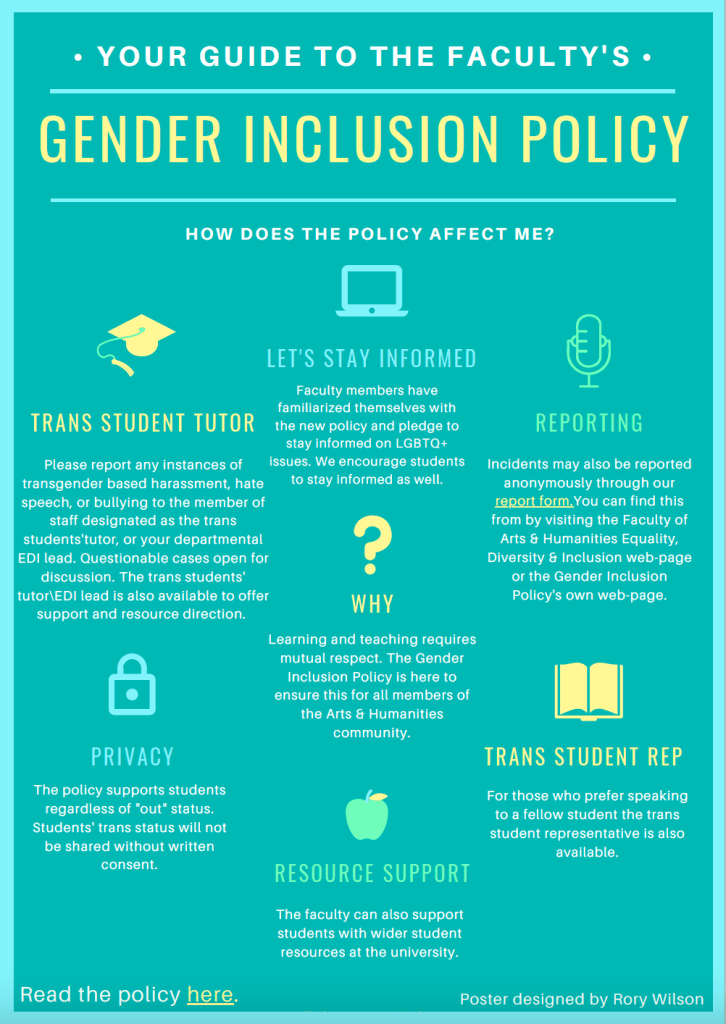
In light of the UK Supreme Court ruling about ‘gender’ in the Equality Act 2010 (reported on here and further discussed here), now is a good time to reiterate that Philosophy at Sheffield, and the Arts & Humanities faculty, has a Gender inclusion policy (see also here), which aims to support and educate about trans inclusion. The page linked sets out our commitments, as well as details the mechanisms at the University of Sheffield for name and pronoun change in our systems.
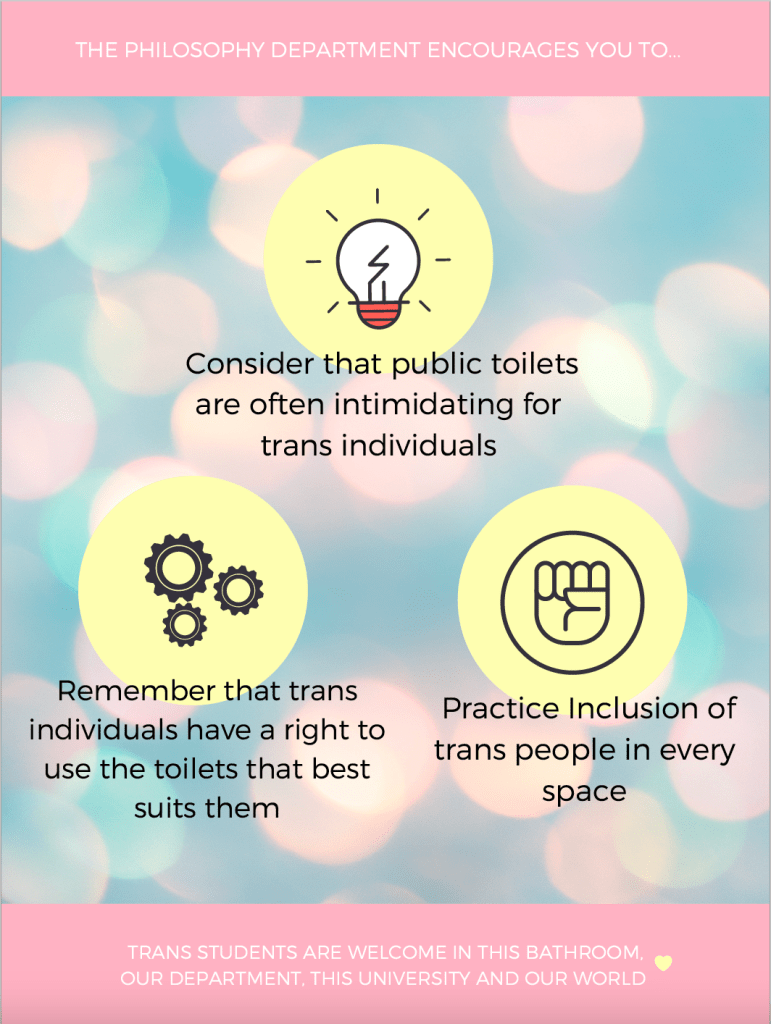
We – like many places on campus – have gender neutral bathrooms (and will continue to do so in the new building to which we are moving this summer) and encourage our colleagues and students to practice inclusion in every space.
In Philosophy we support this in our degree programs (BA Philosophy, and Philosophy Religion and Ethics, as well as our dual degrees), with specialised modules: on LGBTQ studies in year 1, a feminism module which discusses the work of trans inclusive feminists at level 2, and a feminist and queer studies in religion at level 3, which examines lived experiences of queer and trans communities, as well as trans philosophy and trans religious studies.
We also have a long running feminism reading group in which we often discuss, learn from and engage with the work of trans philosophers (this is a great resource).
And, one of the knowledge exchange projects supported in Philosophy and by the Centre for Engaged Philosophy advocates for well designed gender inclusive language in resources supporting pregnancy, birth and parenting.
In Philosophy we recognise and welcome the intellectual and other benefits of inclusion. It is something we recognise we have to continue to work for, and I’m grateful to colleagues who support this work.

If you’d like to hear more about this work, or share your own, please do get in touch!
Poster credits: Rory Wilson
 Centre for Engaged Philosophy